
How Does Generative AI Work?
Generative AI works by learning patterns from enormous amounts of data and then predicting what should come next in a sequence—the next word, pixel, or sound—so it can produce new, human-like content on demand. If you have ever wondered how does generative ai work when you type a prompt and get a full article back, the short answer is deep-learning software running neural networks that were trained to recognize and reproduce complex patterns, then decode them into original text, images, code, and more. That mechanism is worth understanding, because for a business the real question is not just what generative AI is—it is how you want it to work inside your content and SEO workflow.
Table of contents
- • What generative AI actually is
- • The decision behind adopting generative AI
- • Under the hood: training, inference, and feedback
- • Why the mechanics matter for content and SEO
- • Three ways to put generative AI to work
- • Decision criteria for using generative AI responsibly
- • Risks to understand before you scale
- • How our generative AI works for hands-off organic growth
- • Frequently asked questions
What generative AI actually is
Generative AI is a branch of artificial intelligence focused on creating new content rather than just analyzing or classifying existing data. Instead of answering "Is this email spam?" or "What category is this product?", a generative model responds to a prompt by composing text, rendering an image, writing code, generating audio, or synthesizing video that resembles human output.
At the core are deep learning models—large neural networks loosely inspired by how neurons connect and fire in the brain. They are trained on huge datasets and learn statistical relationships between tokens, which can be words, subwords, pixels, or sound samples. Those patterns are encoded across millions or billions of parameters. Once trained, the model decodes those patterns to generate new content that matches the style, structure, and semantics of what it saw, without storing or copying the original data.
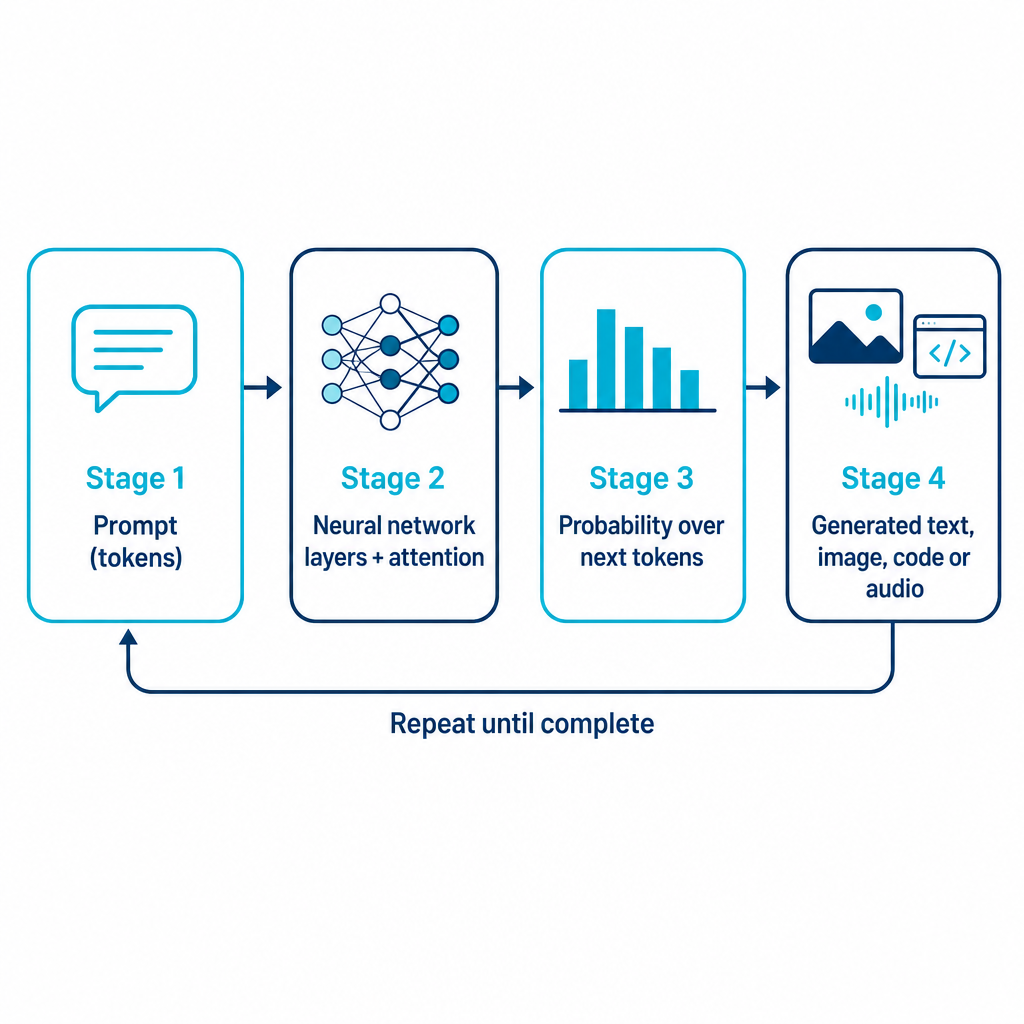
For language, image, and many multimodal systems, the dominant design is the transformer: a neural network that uses attention mechanisms to weigh how different tokens in a sequence relate to one another and to predict the most likely next token. That single operation—next-token prediction—is what powers the tools that write articles, answer questions, or describe images from your prompt.
The decision behind adopting generative AI
For small business owners, SaaS founders, and marketing teams, the technical question quickly becomes a practical one: how do we want generative AI to work inside our business? You are not simply deciding whether to use AI. You are deciding how much of your content workflow should be automated versus human-led, which parts of the process—research, drafting, optimization, publishing, analytics—the AI should own, and which platform you trust to orchestrate the whole thing.
That trust question splits into three realistic paths: wiring up foundation models yourself, leaning on generic writing tools, or using a specialized system built for SEO content and organic growth. The trade-off underneath all of them is control versus outcomes—balancing the scale and speed of generative AI against brand safety, accuracy, and durable SEO performance.
Under the hood: training, inference, and feedback
Generative AI runs on three distinct phases, and understanding each one explains both its strengths and its failure modes.
The first is training. The model is exposed to vast datasets—text corpora, code repositories, image collections, audio archives—and repeatedly tries to make simple predictions, such as the next word in a sentence. It is corrected based on whether it was right. Over many iterations it adjusts its parameters to reduce prediction error, gradually absorbing grammar, style, semantic relationships, visual features, and long-range dependencies. The result is a foundation model: a general-purpose system that can understand prompts across many domains. Most enterprise-grade systems then go through tuning, where the base model is adapted to specific tasks—support, coding, marketing copy—using domain-specific data and feedback, and where safety layers and guardrails are applied to align outputs with business requirements.
The second is inference. Once deployed, the model takes your input and generates content in real time using the patterns it learned. For a language model, it encodes your prompt as tokens and passes them through the network. Attention mechanisms evaluate which tokens matter most in context—your brand name, a target keyword, a tone instruction. The model then computes a probability distribution over possible next tokens, samples one based on settings such as temperature or top-k, and repeats until the output is complete. Image and audio models follow similar principles, but instead of predicting words they iteratively refine structured noise into a final image or waveform. The mechanism is still probabilistic generation guided by learned patterns; only the output domain changes.
The third is continuous evaluation. Modern systems are not static. Many providers run a loop of generation, evaluation, and retuning, using feedback signals and performance metrics to improve quality, reduce bias, and adjust style. In marketing, that loop can be extended to SEO signals: how content ranks, how often it is cited, engagement, and conversions. Those signals help refine prompts, templates, and workflows so the AI learns what "good" looks like for a specific audience—not just what is statistically likely.
Why the mechanics matter for content and SEO
Once you know that generative AI is fundamentally a pattern engine, its usefulness for content becomes concrete. It excels at pattern recognition in language, which makes it strong at understanding search intent and structuring content around topics rather than single keywords, drafting long-form articles and product descriptions in a consistent voice, writing meta titles and descriptions from a target keyword, and producing localized variations for different regions and languages.
Because these models learn from massive text corpora, they can mirror human tone and structure while embedding key phrases naturally—useful for content that needs to read well and rank. When that generation is combined with rules and templates, the output maps closely to what search engines expect for informational queries like "how does generative ai work." The catch is that raw generation alone stops at the draft. Turning a draft into ranking, cited content requires research, linking, publishing, and indexing wrapped around the model.
This is the exact intersection we focus on. We use generative AI and an AI-powered SEO layer to research topics, write original brand-voice content, fact-check it, and publish directly to platforms like WordPress, Shopify, Webflow, and Wix on autopilot. We handle keyword research, internal linking, and on-brand images, then push content live and index it via the Google API so it can rank and surface across generative search experiences. If you want the mechanics of the pipeline itself, our explainer on how AI SEO automation works walks through each stage.
Three ways to put generative AI to work
When you decide how generative AI should work for you, implementation usually lands in one of three categories.
Model-level integration. Technical teams connect to foundation models through APIs and build bespoke workflows for creation, review, and publishing. This offers maximal control but demands engineering, data, and prompt-design expertise to produce quality consistently.
Generic AI writing tools. These provide a simple interface for generating copy but usually leave research, SEO strategy, internal linking, and publishing as separate manual steps. They rely on the same generative mechanics without managing the pipeline from keyword through indexing.
Verticalized SEO platforms. Here generative AI is embedded inside an opinionated SEO workflow: the platform decides what to write, generates and fact-checks it, holds brand voice, links internally, auto-publishes to your CMS, and auto-indexes so content can rank and be picked up by AI assistants. This lets a business benefit from the mechanics without stitching tools together or building a large content team.
Which path fits depends on your appetite for building custom systems versus using a turnkey one, and on how tightly you need generation aligned with SEO strategy and brand governance. If you are weighing automation against headcount specifically, our comparison of an AI SEO writing tool versus hiring a writer breaks down the trade-offs in detail.
Decision criteria for using generative AI responsibly
To decide how generative AI should operate inside your organization, evaluate any platform or workflow against a handful of non-negotiable criteria.
Accuracy and fact-checking. Generative models can produce fluent but incorrect statements, often called hallucination. This is a direct consequence of probability-based generation: the model picks the most likely next token, not the most factually correct one. Any serious deployment should pair generation with research grounding from credible sources, structured fact-checking and citations, and human review for high-stakes content. We build research and fact-checking directly into the pipeline so content published daily stays trustworthy rather than purely model-driven.
Brand voice and consistency. Because generative AI learns style patterns, it can imitate almost any voice, but only with clear conditioning. Look for systems that let you define brand guidelines, supply approved samples, and lock in preferred structures and phrasing. This matters most for small businesses and SaaS brands that trade on a recognizable voice but cannot staff a full editorial team. We are built to produce original, brand-voice content that aligns with each business rather than generic posts.
SEO integration and measurement. How well generative AI works for SEO depends on how deeply it connects to search strategy. Keyword research has to inform topics and structure, not just titles. Internal linking needs to be automated intelligently so topical authority builds across the site. Publishing and indexing should be connected so content becomes discoverable quickly by both search engines and generative answer engines. This last point overlaps heavily with generative engine optimization, which is about being cited by AI assistants, not only ranked in traditional results.
Governance and risk management. Enterprise-ready implementations include role-based access, audit logging, content approval flows, and clear data-usage policies. For marketing teams and agencies, that means source data and prompts do not leak sensitive information, generated content stays within legal and regulatory norms, and AI is used proportionally to the risk profile of the content type. Because our system publishes directly to public sites, these guardrails are part of the workflow rather than an afterthought.
Risks to understand before you scale
Knowing how generative AI works also means knowing where it breaks. Because it relies on pattern inference rather than symbolic reasoning, it can produce factual errors that sound confident and human, biases that reflect skewed training data, inappropriate content that violates brand or platform standards, and SEO pitfalls such as thin or over-optimized pages that fail to rank.
These risks are manageable but require deliberate design. Practical mitigations include curated tuning data, layered safety filters, human oversight, and firm editorial standards. For SEO specifically, output has to be original, substantive, and genuinely helpful, in line with search guidelines that emphasize expertise, experience, authority, and trust. We address these risks by combining generation with structured research, fact-checking, and on-brand constraints, then using automated indexing to expose content to real performance data—closing the gap between what a model generates and what actually performs.
How our generative AI works for hands-off organic growth
We are an AI-powered SEO platform built for businesses that want organic traffic and AI visibility without hiring writers or juggling multiple tools. Generative AI is the core engine, but we wrap it in a full content lifecycle: researching topics and keywords with SEO intent in mind, writing original brand-voice content daily, fact-checking and aligning it with your messaging, creating on-brand images and internal links, auto-publishing to CMS platforms like WordPress, Shopify, Webflow, and Wix, and auto-indexing via the Google API so content can rank and be cited by AI assistants such as ChatGPT, Claude, Perplexity, and Gemini.
Because this runs on autopilot and supports more than 150 languages, the abstract mechanics of next-token prediction become something operational: a steady, scalable source of organic growth. If you want to see how this looks as part of a broader automated approach, our guide to autopilot content marketing puts the pieces together.
Frequently asked questions
What does "how does generative AI work" mean in practical terms?
It means a deep-learning system predicts the next element in a sequence—word, pixel, or sound—to build complete, human-like content from your prompt. In marketing, that becomes tools that draft, optimize, and publish content at scale.
Is generative AI safe to use for SEO content?
It can be, when deployed with research, fact-checking, and editorial guardrails that protect accuracy, originality, and alignment with search quality guidelines. We embed those safeguards into the workflow so automated publishing stays brand-safe and search-friendly.
Will generative AI replace human writers?
It automates drafting and optimization, but humans remain essential for strategy, voice definition, and high-stakes decisions. The strongest teams let AI handle repetitive work while people focus on differentiation and creative direction.
How is generative AI different from traditional automation or templates?
Traditional automation follows fixed rules; generative AI creates novel content by learning patterns from data and responding flexibly to prompts. That allows far richer variation, personalization, and semantic depth.
How does our platform use generative AI differently from generic writing tools?
We do not just generate text. We run a full AI-SEO pipeline covering topic research, keyword targeting, brand-voice conditioning, fact-checking, internal linking, on-brand imagery, auto-publishing, and Google API indexing—so generation is one part of a tightly integrated system built for hands-off organic growth.